
Watch · Player questions
Enter the archive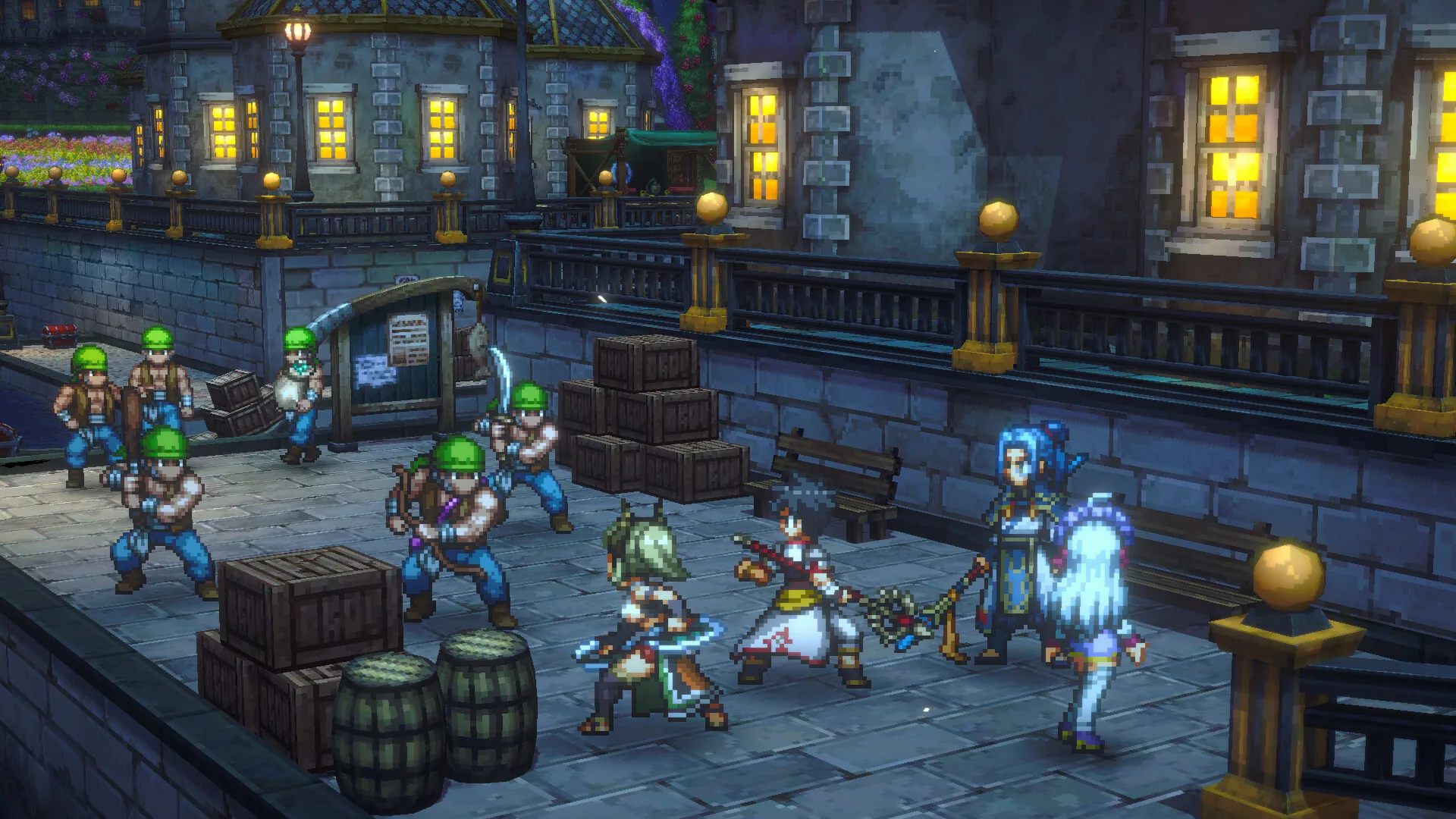
01
What is Suikoden STAR LEAP?
KONAMI classifies Suikoden STAR LEAP as an RPG and describes it as an entirely new addition to the Suikoden series. It is presented as the first Suikoden title tailored for mobile, with a current product surface on iOS and Android. The game’s official premise begins in Solar Year 453, a few years before Suikoden I and after Suikoden V. A lakeside village east of the Scarlet Moon Empire is attacked by mysterious enemies, and the Hero’s group decides to restore it.
The product description also promotes 108 new stars to meet and befriend. The roster page here exposes 39 official character records from the sealed capture, so the archive uses 39 / 108 as a scope marker. That ratio does not say the game has only 39 stars; it says how many detailed records are currently bound to the published character surface. The story, system, and release pages keep their own evidence lanes so the series promise does not become a claim about a complete list.
02
Is the current release mobile?
The current version record is mobile 1.0.1 on iOS and Android, captured on 7 August 2026. The Japanese official product information lists iOS or iPadOS 18 and later with at least 4 GB of RAM, and Android 11 and later with at least 6 GB of RAM. Those requirements are attached to the mobile record. Use the live Apple or Google product page for the final install decision because version information can move after a capture.
Steam should be read as a separate product lane. App ID 3668850 is the Windows Steam listing, and its captured store record does not provide a release date. The release desk therefore uses a date-pending label and keeps Steam’s platform and language notes separate from mobile 1.0.1. A player who wants the PC surface can follow the Steam link without assuming that the mobile requirements or current version number transfer across products. The two records can be compared, but they should not be merged into one release line.
03
How does battle work?
Normal combat uses a timeline turn-based battle system. The official battle surface names normal attacks, runes, and special techniques as choices, so the player can read the command screen as an order-of-action problem. War Mode is a real-time strategy mode with simultaneous enemy and ally units, which changes the timing model rather than simply making normal battle faster. Party Edit supports up to six front and back units, giving the party a visible two-line formation.
The archive does not publish a damage formula or a universal character tier list because those fields are not present in the sealed official system capture. The practical route is to identify the mode first, then use the named system language to understand what the screen is asking. The roster comparison desk can align the identity fields of up to three stars, but it does not turn those fields into an invented optimal formation.
04
Where does the story start?
The opening story is set in Solar Year 453. The Hero is the son of Hou, the chief of a lakeside village east of the Scarlet Moon Empire. Mysterious enemies attack the village, and the Hero, Hisui, Shirin, and Shapur decide to restore it. The official story surface provides that sequence. The Rune of Change is also presented as one of the 27 True Runes, placing the local recovery inside the series’ wider historical vocabulary.
The story page keeps Odessa in the later expansion of the conflict. Odessa is an aristocrat of the Scarlet Moon Empire who rises against the Empire and leads the Liberation Army. That point is connected to the wider historical arc, but it is not used to fill in every scene between the village attack and the rebellion. Players who want the cleanest first read should start with the Chapter 1 disclosure, then use the chronology and Rune sections as anchors.
05
How many characters are documented here?
The official character capture exposes 39 records. Every record has the same five practical fields: name, voice actor, official description, height, and favorite food. The full product promise is 108 new stars, so the page clearly labels the difference rather than pretending that the current capture is a finished 108-person archive. Search can match any of those fields, and the comparison desk can hold three selected records.
Hero has a dedicated detail route because the protagonist is tied directly to the opening village story. His record credits Tomohiro Ono, lists 166 cm and Rice Omelet, and describes him as kind, courageous, and charming. Other cards remain in the full roster because their current records are useful in context: Hou, Hisui, Shirin, Shapur, Odessa, Flik, Viktor, and the wider cast all form a readable constellation without requiring a made-up role chart. The search and compare controls keep that distinction visible while a player moves through the capture.
06
Which pages are observed community data?
The Enemy Codex, Alpha Ulse detail, World Atlas, and Mirage Tower are noindex field references. They use captured community records from Kaiden and show their scope beside the values. Alpha Ulse has a detailed observed block: level 50, Water, 872 HP, 139 P. Atk, 10 M. Atk, 399 P. Def, 399 M. Def, 66 SPD, 72 HIT, 72 DODGE, Wisdom and Lightning weaknesses, and Sword and Fire resistances. The Academy Interior map has ten observed markers on map 76-0, and Mirage Tower has two chamber records plus seven weekday rows.
Noindex does not mean unusable. It means the narrow reference should not make a broad search promise from a partial capture. A player can use the map or tower selector for a known task, then verify a version-sensitive detail in game. The official battle and exploration pages remain the right source family for the named systems, while the field pages remain honest about their community observation status.